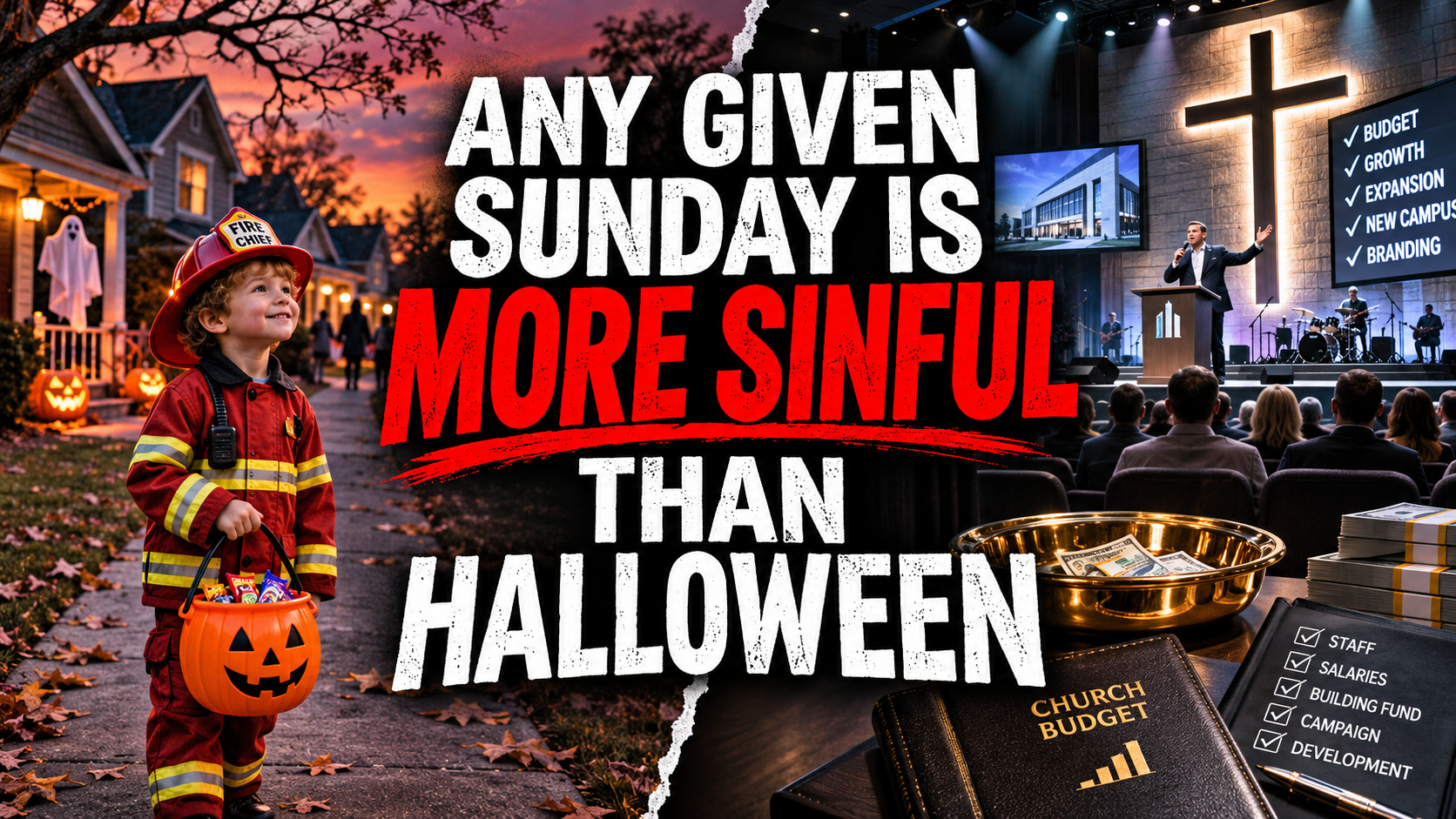
1. Christians Know How to Condemn the World's Darkness
Christians have become remarkably skilled at identifying sin outside the church.
Halloween is an easy target. It has witches. Skeletons. Demons. Ghosts. Occult symbols. A complicated history involving both Christian observances and pre-Christian traditions.[iii]
Every October, Christians remind one another about Ephesians 5:11: "Take no part in the unfruitful works of darkness, but instead expose them."
That's a good verse. Take it seriously.
Scripture condemns sorcery, divination, idolatry, and participation in occult practices. Christians have legitimate reasons to reject activities that glorify evil. But here's where our discernment becomes strangely selective. We'll apply Ephesians 5:11 to a neighborhood Halloween party without hesitation, yet when the same verse demands we examine greed, exploitation, and hypocrisy inside our pulpits, suddenly everything becomes complicated.
Suddenly, we don’t judge. Suddenly, we're told pastors should be paid. Suddenly we're warned against touching God's anointed. Apparently, Christians are expected to expose the works of darkness everywhere except where they tithe. And that's where we've missed it.
Understand, believers shouldn’t stop looking for darkness outside the church.
I'm not suggesting Christians should ignore Halloween's darker associations.
I’m suggesting we stop getting distracted by endless debates over holidays while the real problem happens every Sunday. That we stop turning a blind eye to the darkness within our own churches—darkness that's arguably far more dangerous because it's everywhere, it’s subtle, and it’s so deeply normalized that most American Christians don’t recognize it as sin.
Christians are busy asking if a holiday has become too worldly, when we should be asking if our churches have. Because the greatest danger isn't a pagan celebration outside the church, it's a corporate church culture of comfort that lulls its members to sleep and profits off the name of Jesus. And if we're willing to condemn holidays in the name of holiness, we must be willing to condemn fraud and theft, too—which is what is happening in churches across America.
Any given Sunday can be more sinful than Halloween. Not because gathering for worship is sinful. Not because financially supporting faithful ministries is wrong. But because corporatization and commercialization are sins if they’re happening inside the church, which they most definitely are.
2. Scripture Gives Us Three Ways to Approach Culture
There's a helpful framework for understanding how Christians should engage with the world.
Receive. Reject. Redeem.
Some things are good gifts from God, and Christians should receive them with gratitude. Other things are inherently sinful and must be rejected. Still others contain elements that can be redeemed for God's glory.
This framework should be applied to Halloween.
A family might reject the occult while participating in a scary neighborhood gathering. They might allow their kids to dress up and enjoy time with friends without becoming witches. They may even use the evening to show hospitality, serve neighbors, and share the gospel.
The question becomes whether the thing itself is sinful and what participation communicates. But here's what fascinates me.
Why don't we apply the same framework to the modern American church?
Should churches receive 501(c)(3) tax-exempt status? Is it biblical to establish corporate boards with authority over the elders and other God-ordained offices of autonomous congregations? Can tax filings, W-2s, payroll systems, business operations, and nonprofit governance structures be reconciled with, or even redeemed by, the New Testament's model of the church?
I ask because something has gone terribly wrong.
Somewhere along the way, churches stopped looking like communities of believers devoted to one another and started looking like corporations here to maintain themselves. They have executive leadership teams. Marketing departments. Branding strategies. Expansion campaigns. Real estate portfolios. Revenue projections. Employee performance metrics. And congregants whose primary financial responsibility is to keep the operation running.
If Jesus and the Old Testament teach us anything, it's that when pastors get their hands on money, the machinery of religion has a dangerous tendency to become more important than the people it supposedly exists to serve. Hence, Micah 3:11-12 says:
Her leaders judge for a bribe,
her priests teach for a price,
and her prophets tell fortunes for money.
Yet they look for the Lord’s support and say,
“Is not the Lord among us?
No disaster will come upon us.”
Likewise, this is precisely why Peter warned elders to shepherd God's flock "not for shameful gain, but eagerly" (1 Peter 5:2). Apparently, religious leaders profiting from their spiritual positions while claiming God's approval and turning God's people into a source of income, aren’t modern inventions.
Frankly, the corporation has swallowed the church. And Christians who wouldn't dream of redeeming any part of Halloween are comfortable receiving corporate Christianity without question.
ENDOTES
[iii] Before deciding if Christians should participate in Halloween, understand where the holiday came from. The word Halloween comes from All Hallows' Eve, the evening before All Saints' Day. Historically, All Saints' Day was a Christian observance commemorating saints and martyrs who had gone before. The word hallow means holy or sacred. It's the same word found in the Lord's Prayer ("Hallowed be thy name."). But Halloween also developed alongside older European customs, including traditions associated with the Celtic festival of Samhain. Samhain marked the transition from the harvest season into winter and was associated with beliefs about spirits and the supernatural. As Christians spread through Celtic regions, Christian observances and local traditions increasingly overlapped. Over centuries, these customs evolved, mixing religious commemorations, folklore, seasonal festivities, and eventually commercial entertainment.
Modern American Halloween became largely associated with costumes, candy, neighborhood gatherings, decorations, and parties. So which version of Halloween are Christians debating? A pagan religious festival? A Christian remembrance of the dead? A modern commercial holiday? A child's opportunity to dress up and collect candy? The answer matters. A holiday's historical associations are worth examining, but they don't automatically tell us the moral meaning of every activity practiced on that holiday today.
