Introduction
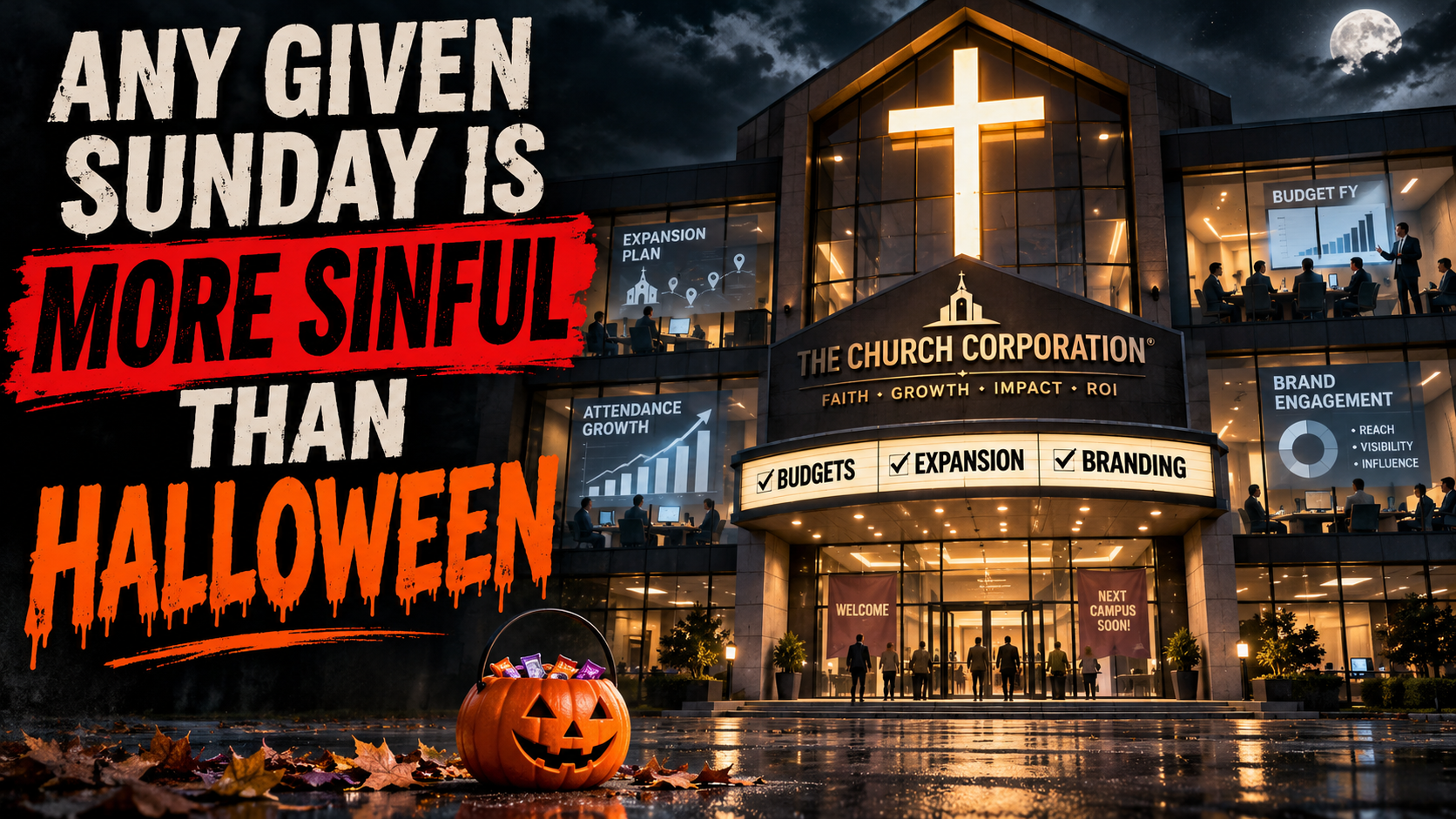
Christians spend October condemning Halloween, then spend every Sunday financing churches that have become corporations. Maybe the real spiritual darkness isn't in the streets trick-or-treating or at costume parties on October 31. Maybe it's behind the pulpit.
Every October, Christians ask the age-old question.
Should Christians celebrate Halloween?[i]
Parents warn their kids about it. Christians argue about its pagan origins, demonic associations, witches, costumes, candy, and if participating in the holiday compromises their witness.
We're told to have nothing to do with the works of darkness (Ephesians 5:11). We're told to come out from among them and be separate (2 Corinthians 6:17). We're told that Christians cannot participate in idolatry and expect God to approve (1 Corinthians 10:20–21).
Fair enough. But I have a question: Why are Christians so concerned about the little paganism outside the church while ignoring the bigger paganism inside it?
Jesus said it this way:
"Why do you see the speck that is in your brother's eye, but do not notice the log that is in your own eye?" (Matthew 7:3)
Why do we spend so much time on a holiday associated with greed, commercialism, and spiritual darkness, only to return every Sunday to church corporations built around greed, commercialism, and spiritual darkness?
My guess is because bashing October 31 is low-hanging fruit.
We'll condemn kids dressing up but defend a pastor dressing up to turn the household of God into a business, which is precisely the kind of religious corruption Jesus confronted:
"My house shall be called a house of prayer, but you make it a den of robbers." (Matthew 21:13)
We'll warn Christians about participating in a potentially redeemable holiday with pagan associations while participating in a church corporation that uses the name of Jesus to accumulate debt and secure its own financial future.
Yet Paul writes: "Owe no one anything, except to love each other" (Romans 13:8). And James warns those who confidently presume upon tomorrow while pursuing their financial ambitions: "Come now, you who say, 'Today or tomorrow we will go into such and such a town and spend a year there and trade and make a profit'—yet you do not know what tomorrow will bring" (James 4:13–14).[ii]
Ironically, before condemning the world for violating scripture, take a good look at your own church's financial statements. There's a good chance your church disregards the very warnings of Paul and James—stockpiling substantial savings, pouring enormous sums into salaries and operations, and planning multimillion-dollar building projects for needs that may never even exist. Meanwhile, widows and single mothers in your own congregation struggle to pay rent, put groceries on the table, or keep their vehicles running.
We'll refuse to give children candy on October 31 but enthusiastically give our money to board members who have built careers around extracting offerings from poor church people.
And somehow, we think we're the ones standing against darkness.
Maybe the greatest spiritual danger facing the American church isn't what Christians do on Halloween. Maybe it's what we've normalized every Sunday.
In this series, we'll open church closets and examine six skeletons that should scare Christians more than anything they'll encounter on Halloween.
ENDOTES
[i] Ask better questions. Rather than beginning with a blanket prohibition or permission, Christians can approach Halloween by asking several biblical questions. (1) What exactly am I participating in? Is this an ordinary community activity, or does it involve celebrating occult practices, evil, or idolatry? (2) What does scripture say about the activity itself? We should distinguish clear biblical prohibitions from matters of personal conviction. (3) Does participating violate my conscience? If you cannot participate in faith, you should abstain. (4) Am I judging other Christians by convictions that scripture doesn't universally require? Christian liberty requires humility toward believers who reach different conclusions on disputable matters. (5) What does my participation communicate within my community? Could my actions reasonably be interpreted as endorsing occult worship or compromising Christian faith? (6) Could my participation cause another believer to stumble? Love should govern how we exercise our freedoms. (7) Can this be used to glorify God and love others?
Sometimes the most faithful response is to reject a cultural practice. Sometimes it's to receive an innocent activity with gratitude. And sometimes it's to redeem an opportunity for something good.
[ii] Romans 13:8 warns against outstanding obligations, but Christians disagree on whether it prohibits all borrowing. James 4:13–16 condemns arrogant financial planning that disregards God's will, rather than financial planning itself. But such responses miss the point. The argument isn't that churches borrow money or maintain some savings. It's that churches condemn the world's financial presumption while practicing their own form of it—committing enormous resources to institutional security and future expansion while neglecting present needs of the people God has entrusted to them.
