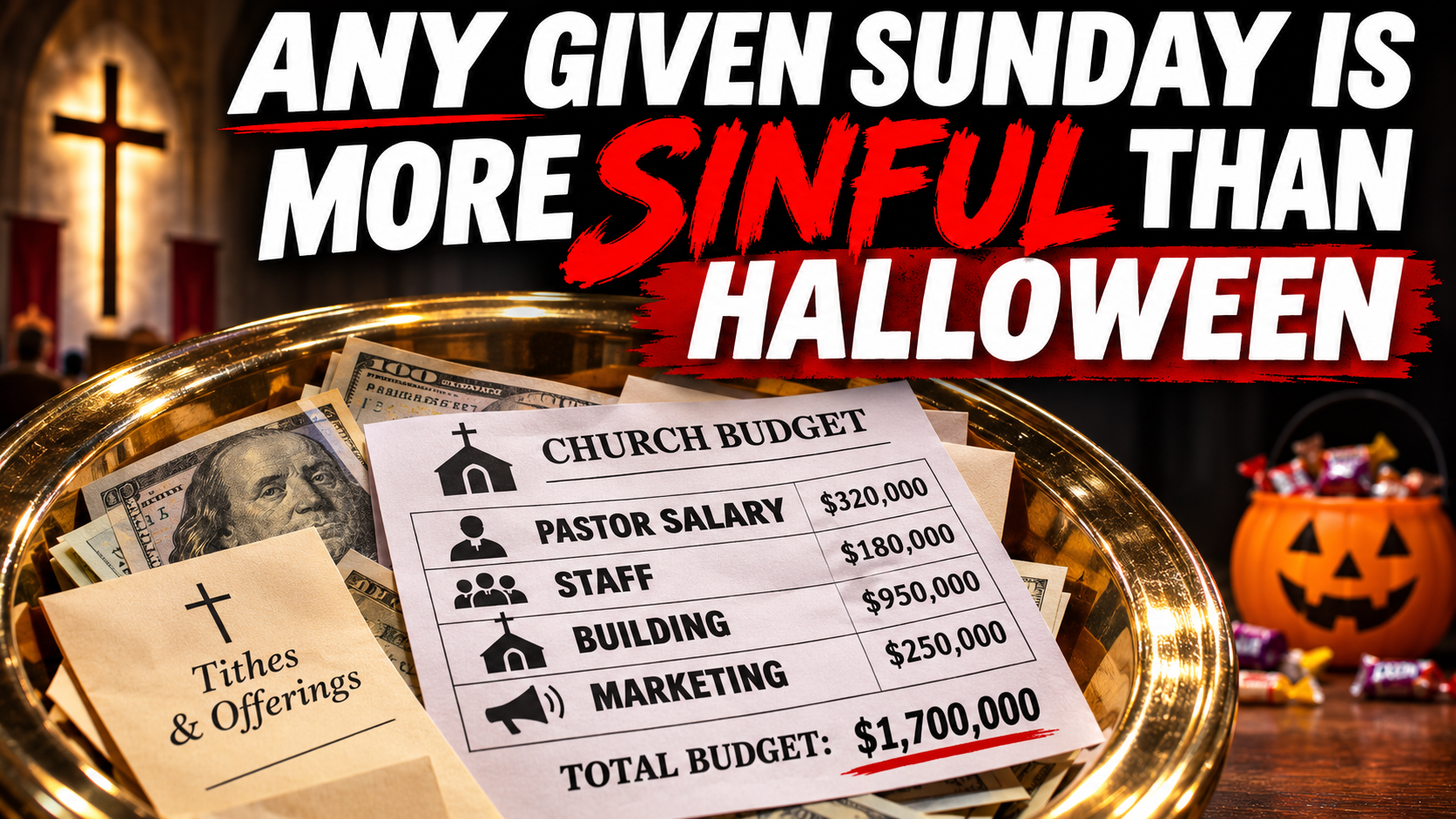
5. The Early Church Took Care of People. The Corporate Church Takes Care of Itself.
Look at the church described in Acts. Acts 2:44–45 describes believers sharing their possessions and distributing resources according to need. Acts 4:34–35 describes a community where resources were distributed to those who lacked necessities. Acts 6 shows church leaders addressing the neglect of widows.
The early church wasn't a perfect community. The New Testament records its failures and conflicts. But caring for people was central to its financial life.
The church's resources were used to meet real human needs. Caring for the poor wasn't some optional ministry tucked away in the church budget. It was central to the apostles' mission. Paul himself wrote, "All they asked was that we should continue to remember the poor, the very thing I had been eager to do all along" (Galatians 2:10). Apparently, the apostles considered caring for the poor a priority worth preserving.
Now contrast that with a modern church where the largest financial commitments involve property, payroll, debt, and institutional maintenance. It’s clear that we've made preserving the business of church a greater priority than caring for its people.
A family in your congregation is drowning in medical bills. A father is struggling to provide the care his disabled child needs. A mother desperately wants to give her child a Christian education instead of sending them to public school, but she can't afford the tuition. A brother battling addiction needs friendship, counseling, therapy, and a steady job to help him get back on his feet. These aren't hypothetical ministry opportunities. These are real people with real needs—the very people the church is supposed to care for.
But the church is launching another fundraising campaign for building improvements.
Something is wrong here.
A church can have a beautiful building and still be spiritually impoverished. It can have talented musicians, professional lighting, sophisticated marketing, and impressive attendance while failing to care for the people sitting in its pews. It can preach biblical truth while stewarding itself in ways that prioritize comfort over compassion. Perhaps most tragically, it can persuade struggling Christians that giving more money is the solution to their spiritual problems, when it’s supposed to be the other way around.
A church that neglects needy people to preserve its own financial comfort has confused its mission with its maintenance and will go to hell.
Remember that Jesus warned of eternal judgment for those who neglected Him in the hungry, the stranger, and the vulnerable (Matthew 25:41–46). The church exists to serve Christ, who so closely identifies Himself with His people that He says, “Whatever you did for one of the least of these brothers and sisters of mine, you did for me” (Matthew 25:40). Christians do not exist to keep a religious corporation financially solvent. The church exists to care for Christ's people, not to make a successful business off them.
6. We've Become More Afraid of Halloween Than Greed
Again, here's the contradiction I can't get past.
Christians will condemn Halloween because of its associations with darkness. They'll refuse to participate in activities they believe are connected to idolatry or spiritual corruption. They'll warn one another about the dangers of compromising with the world. And then they'll walk into churches where greed is openly disguised as ministry.
Where financial manipulation is called stewardship. Where institutional loyalty is mistaken for faithfulness to God. Where pastors function like executives, congregations function like customers, and offerings function like recurring revenue.
But nobody calls that worldly. Nobody calls that compromise. Nobody calls that darkness.
Why? Because it happens inside a church building? Because someone attached Bible verses to it? Because the person collecting the money has a title in front of his name?
Scripture has plenty to say about greed.
Jesus warned:
"You cannot serve God and money." (Matthew 6:24)
Paul warned about those who imagine godliness as a means of financial gain (1 Timothy 6:5). Peter instructed elders to shepherd God's people willingly and not for shameful gain (1 Peter 5:2). James condemned religious claims that fail to meet the practical needs of people lacking food and clothing (James 2:14–17).
These aren't minor concerns. They're central biblical warnings. And unlike the question of whether a child can wear a costume on October 31, greed and exploitation are not disputable matters. Christians will debate whether Halloween candy is contaminated by paganism while unquestioningly financing ministries contaminated by greed. And somehow we've convinced ourselves that the candy is the greater spiritual danger.
Conclusion
Now we return to the question that started this discussion.
Should Christians celebrate Halloween?
My answer? Most Sundays are more sinful than Halloween.
We've spent so much time debating if Christians can participate in a holiday that we've ignored the ways pagan values have been welcomed into our own churches. Corporate ambition. Wealth accumulation. Institutional power. Status. Self-preservation.
These things don't become Christian because they're called “church” and done on Sundays.
A church isn't faithful because people show up. A pastor isn't righteous because he uses a Bible. An offering isn’t holy because money moves from your bank account into the church's.
Jesus didn't measure fruitfulness the way today’s churches measure success. He didn’t tell us to measure the faithfulness of His church by its events and facilities, the sophistication of its organization, the comfort of its members, or the financial security of its business.
He called His followers to love God and love their neighbors. Feed the hungry. Care for the vulnerable. Practice justice and mercy. Reject greed. Serve rather than be served.
If our churches have abandoned those priorities to corporate success, then the problem is far more serious than a child dressing up in something fun or scary and trick-or-treating for candy on October 31.
If we're going to condemn compromise, let's start by cleaning out the skeletons in our own church closets. If we're going to expose darkness, let's expose it even when it's hiding behind our favorite pulpits, quoting scripture, or making me happy by making me feel important because it lets me do what I want and volunteer for stuff. Before we lecture the world about Halloween, perhaps we should try obeying what Jesus said about caring for the poor with our ministries and moneys instead of obsessing over what He never said about October 31. Until we do, your normal church Sunday that you enjoy so much may be more dangerous and thus scarier to your soul than anything happening in your neighborhood on one day for Halloween.
